
Frozen Shoulder & Life Transitions

Zena Takieddine
December 24, 2025 | 23 min read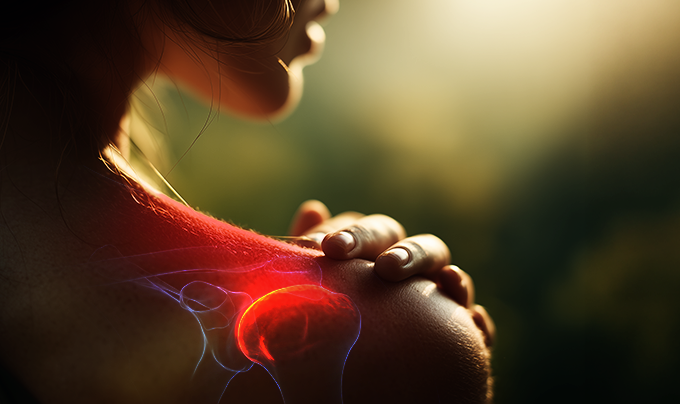
Jump to sections
Isn’t it a strange thing to say, “Frozen Shoulder”?
How can a shoulder freeze?
Physicians don’t have a clear answer as to why this phenomenon happens. Its scientific name, adhesive capsulitis, describes the situation, as it literally means the joints have gotten stuck together. But there is no direct correlation to a particular cause or injury. Isn’t that interesting? What would make the joints get sticky like that? Their main function is movement, yes, connecting the strength of muscles to the structure of bones, in order to move in particular ways and purposes. The exact cause is often unknown, but though it frequently occurs after immobility due to injury or surgery, or other factors limiting shoulder movement, such as sedentary lifestyle.
The Anatomy of the Shoulder
So let’s get curious about the anatomy of the shoulder. Shoulders are very interesting joints, and they’re not quite like anywhere else in the body. Often we call them a ball-and-socket joint similar to the thigh and hip relationship. But the rotational field is more clearly defined and supported by the hip than what we have in the shoulder, where the rounded head of the upper arm bone (humerus) fits into a relatively shallow cup-like socket (glenoid cavity) on the shoulder blade (scapula). This allows for a wide range of arm movements like rotation, lifting, and swinging. But this joint, compared to the hip joint, is relatively unstable because the socket is shallow and relies on muscles, tendons (especially the rotator cuff muscles), ligaments, and a cartilage ring called the glenoid labarum for stability.
This agility of the shoulder also involves the synovial membrane, which produces the synovial fluid. This fluid’s main function is to provide lubrication to reduce friction between the cartilage of the joints during movement, to provide shock absorption against impact, and supply oxygen and nutrients to the cartilage, and to remove metabolic waste from the cartilage cells.
The best way to keep synovial fluid in good form and avoid stiffness is with gentle mobility, moving the limbs and joints with mindful awareness. It is natural for the flow of synovial fluid to get lethargic with age, so this occurrence is not a sickness per se, but one of the natural signs of aging. Nonetheless, it can cause a sense of pain and stiffness in the joints, particularly in the mornings, since the body has been asleep and immobile for some time. As such, it is a good idea to begin your morning with gentle movements and joint rotations as a way to wake up the fluid before getting out of bed. We naturally do this when we stretch spontaneously as we transition from sleep to waking up. It is really good and really important to enjoy these morning stretches and feel them all across the body and spine.
Isn’t it a strange thing to say, “Frozen Shoulder”?
The Physical Anatomy of Frozen Shoulder
Frozen shoulder is a condition characterized by stiffness, pain, and limited range of motion in the shoulder joint. Anatomically, it involves the shoulder joint and its surrounding structures, particularly the joint capsule and the synovial membrane. The main muscles that can be affected by the stiffness and limited range of motion associated with Frozen Shoulder include:
- Rotator Cuff Muscles:
- Supraspinatus: Assists with abduction (lifting the arm away from the body).
- Infraspinatus: Aids in external rotation of the shoulder.
- Teres Minor: Also helps with external rotation.
- Subscapularis: Facilitates internal rotation of the shoulder.
- Deltoid: Responsible for lifting the arm and shoulder movements in various directions.
- Pectoralis Major: Involved in internal rotation, adduction (bringing the arm closer to the body), and flexion of the shoulder.
- Biceps Brachii: Contributes to shoulder flexion and assists with lifting the arm.
- Trapezius: Helps with shoulder elevation and rotation of the scapula.
- Rhomboids: Assist in stabilizing and retracting the scapula.
- Latissimus Dorsi: Involved in shoulder adduction, extension, and internal rotation.
- Teres Major: Works with the latissimus dorsi in internal rotation and adduction of the shoulder.
In Frozen Shoulder, the shoulder joint capsule becomes thickened and tightens, leading to the restriction of these muscles. The limited movement and stiffness can cause pain and weakness in these muscles due to disuse and immobility.
Stages of Frozen Shoulder
Frozen Shoulder typically develops gradually and progresses through three stages:
- Freezing Stage: During this initial stage, any movement of the shoulder causes pain, and the range of motion starts to become limited. This stage can last from six weeks to nine months.
- Frozen Stage: In this stage, the pain may begin to diminish, but the shoulder becomes stiffer, and using it becomes more difficult. This stage can last from four to twelve months.
- Thawing Stage: During the final stage, the range of motion in the shoulder slowly begins to improve. Complete recovery may take anywhere from six months to two years.
In terms of occurrence, there is a slight prevalence for the non-dominant shoulder – the left shoulder if you are right-hand dominant, the right shoulder if you are left-hand dominant - except in cases comorbid with diabetes, in which case the Frozen Shoulder of right shoulder is slightly more common. However, it is uncommon for both shoulders to freeze at the same time.
It’s also helpful to know that sometimes, after one shoulder has healed, the other shoulder may experience the same issue several months or even years later. So do not be alarmed if that happens. Seeking support is important. The progression through the stages of the condition can take anywhere from 1 to 3 years. How long any of the stages take varies from person to person. Getting support early on can help reduce the intensity of the experience, increase the ability to cope with the experience, and support the progression through the stages.
The “Language” of the Shoulders
So we got into technical aspects of the Shoulder and Frozen Shoulder. What about symbolic aspects? What might a Frozen Shoulder mean to us symbolically? Well, how do we relate to the shoulders? Consider the phrases and idioms we use as modes of expression or states of being. Perhaps it is not a surprise to discover also the wide range of meaning, emotions, and relational attitude that emerge. For example:
To put your shoulder to the wheel: To put a lot of effort and hard work into achieving something.
To shoulder the burden: To take on the responsibility of something difficult or unpleasant.
To have a chip on your shoulder: To take a position of aggression, ready to pick a fight.
To give someone the cold shoulder: To deliberately ignore or be unfriendly to someone, to turn away from them, total disregard.
To have one’s shoulders droop: To feel defeated, disappointed, or depressed.
To cry on someone's shoulder: To tell someone your problems and seek their comfort and support.
To be a shoulder to cry on: To be a friend and source of emotional support for someone who is going through a hard time.
To stand shoulder to shoulder: To stand united as a team or a community, a form of brotherhood and togetherness, equality and mutual support.
What can be revealed by these expressions? How do they relate to shoulder function, not just mechanically, but as expressions of us, as a living, breathing, aspiring human being?
Note the interpersonal dimension of these expressions. From a holistic well-being perspective, optimal health in body and mind arises when we move through life with a sense of integrity and alignment of thought, feeling and action, as well as a sense of inter-dependence, like being within a healthy ecosystem where everyone is supporting everyone else and being supported by everyone else in a dynamic balance. However, when we are overburdened, disconnected from core strength and collective belonging, the easy flow of energy, relationship and work starts to cause wear and tear. How might bearing burdens through our limbs without maintaining our core power and breathing capacity cause accumulation of pressure over time, and lead to, or aggravate Frozen Shoulder?
The Psychological Factors of Frozen Shoulder
And there is more to consider. As noted, the medical field has not identified specific causes for Frozen Shoulder. Though, they have found correlations between different conditions, including Diabetes, Thyroid Disorders, Parkinson’s Disease, Autoimmune Disease and Cardiovascular Disease.
That being said, there is a prevalent association between Frozen Shoulder and psychological factors such as chronic stress, depression, anxiety and emotional trauma. There is also the mental compulsion of “pain catastrophizing” a psychological phenomenon where there is a cognitive pattern of catastrophizing the experience of actual or anticipated pain. This involves excessive focusing on the pain, magnifying its threat, and feeling helpless to control it, all of which can make conditions like Frozen Shoulder feel much worse. [Check out our article on mindfulness and meditation for more information on pain reduction]. Pain catastrophizing, stress, depression, anxiety and emotional distress have all been associated with influencing the onset, severity and recovery from Frozen Shoulder.
Interestingly, Frozen Shoulder is more likely to occur among women than men. Some statistics show a different as high as 70% among women compared to 30% among men, At the same time, the prevalence among women is higher during midlife.
So what is happening during midlife? We know that women are going through perimenopause and menopause. These involve significant changes in the women’s hormones. In fact, studies indicate that hormone replacement therapy may be a preventative factor to the development of Frozen Shoulder.
But what else is happening during this time? The period of mid-life is a big transition for women in their lives and can present many challenges and stressors. Some women – as well as men - are navigating the entry of the empty-nest phase with their partner, as they watch their children leave the home to go to university and work. They find themselves suddenly facing the question of meaning and purpose in their life, or feeling a kind of grief of loss. Others may be in the midst of their careers and are either faced with the experience of dissatisfaction of where the road has led them, or exhaustion of the weight and strain the responsibility has placed on them. Things did not quite turn out as they had hoped. The dreams of the younger years are usually met with a reality check and disillusionment. While there can be maturity in growing older and wiser, there can also be a bitterness, an exhaustion, or a depletion of energy. All of these can aggravate and contribute to the experience of Frozen Shoulder, especially among women who are also facing significant hormonal and circumstantial changes in their lives.
Frozen Shoulder, the Layers of Relationship
A holistic perspective on wellness asks us to consider the different layers of relationships that could be contributing to the development of dis-ease. And with Frozen Shoulder, we can do the same. The connection between grief and the chest is already recognized by alternative healing perspectives. How might that be connected to our shoulder? And what about the connection between our shoulders and our desires? Our shoulders and our emotions?
Consider how close our shoulders are to the heart, the center from which we often experience feelings of emotional expansion, elation, love, gratitude, and even contraction.
Our heart, our shoulders, our arms, our hands.
We can express the desires we feel in our hearts by the movements we make from our shoulders through our arms and hands. While our elbows allow our arms to fold towards us and back out again, it is through our shoulders that our arms can rise from the natural gravity-related lowered position, to lift upwards, extend outwards, and swing in circles. And it is with our arms that we can reach out and pull something closer to us, or push out and move something away from us. Might it be, then, that Frozen Shoulder is somehow also related to emotional relational pain? What happens if we feel grief in our hearts? Do the muscles near the heart constrict also? Might the shoulder joint tighten and get stuck?
And what happens when we find difficulty expressing our desires? Whether it’s the desire to reach out for something, or the desire to push something away and assert a clear boundary? Can you imagine how addressing these layers holistically helps bring relief sooner?
SOMATIC EXPLORATION
Somatic therapy has been gaining recognition as an important holistic healing approach. So what else happens when we consider somatic layers further?
How does our body function? How does the energy flow through our body?
There is a natural alignment when our core, our torso, is the source of energy and vitality through which the limbs grow and carry out all the necessary movements that are needed in relation to the outside world. Our torso includes our chest and abdomen. We can almost imagine that the energy begins from our center, from our torso. It flows from the chest and upper body into the arms, and from the abdomen to the lower body and legs. And the rhythm of the breathing diaphragm helps create a sense of cohesion and flow between center and periphery. There is a naturally healthy rhythm within. The body knows how to regulate. It knows how to flow.
Oftentimes, when we hold our breath, stiffness starts to emerge in the various joints and limbs. There are many reasons to unwittingly hold our breath. Much of it has to do with shock and overwhelm. As this happens, bit by bit, we develop less-than-optimal breathing patterns. The diaphragm constricts, the alignment does not flow, and joint pains start to emerge. This is one way of imagining how joint pain and constriction can develop gradually over time.
Connections are found between the shoulder and the neck as well. Important nerves, arteries and veins are traveling between the brain and body via the neck, including the vagus nerve. Scrunching down the head and hiking up the shoulders towards the ears is a spontaneous defensive response that protects the neck; i.e. ducking. Feeling tense, anxious, and afraid also builds up this kind of tension, a state of hyper alert. Conversely, being able to drop the shoulder and turn the neck easily from side to side indicates a relaxed nervous system and overall state.
How do we connect these aspects with the relational layers described above? Alternative healing perspectives see the connection between grief and the chest, lungs and thoracic area. How might that be connected to our shoulder? How does our breath move around the shoulder area, the clavicles and the armpit and upper thoracic? How available are we to embrace others, or to carry others, or to dance with others, or to fight with others, or to let go? Have others been a source of threat and burden, or joy and connection? It is with our shoulders that we can flap our arms up and down as if we are flying. Our shoulders are like our wings. How free do we feel to fly? These kinds of somatic feelings can bring some insights into what is going on beneath the physical symptoms.
A Holistic Approach to Treating Frozen Shoulder
Frozen Shoulder is a common condition that can cause a lot of pain, discomfort, and restriction. Given the different aspects that may be contributing to Frozen Shoulder, as well as the impact it can have on one’s overall wellbeing, a holistic approach to treating it is the better way to go about it.
Most people don’t seek any therapy until pain and discomfort have become intense. A treatment plan with a pain management strategy for direct relief may involve corticosteroid injections, and, in severe cases, surgical intervention to release the tightened joint capsule. However, it is always better to try less invasive approaches first, whenever possible.
Physiotherapy for shoulder pain and stiffness is usually the first part of the treatment protocol for Frozen Shoulder, since it is the limitation of movement that gets people to finally address the issue. Treatment typically involves physical therapy to restore movement, and this takes some time since the stuckness accumulates in layers. Physiotherapy is most beneficial during the frozen and thawing stages, helping improve range of motion and function. It requires consistent treatment and regularity for at least 6 months to a year, sometimes longer. The total duration of frozen shoulder may be 12 to 60 months, heavily influenced by how well patients comply with physiotherapy exercises and tolerate them. Ideally, supporting healthier joint mobility, doing gentle exercise regularly and creating a meditation practice for holistic alignment of body, heart and mind can liberate a Frozen Shoulder and keep it from recurring.
Lifestyle practices such as meditation, yoga, and clinical pilates can make the physical care truly comprehensive, safely supporting the shoulder to un-freeze and the whole body to find greater agility and ease.
It is also important to address any hormonal factors contributing to the condition. As highlighted, the middle age phase in life is a period of significant physical and hormonal change for both men and women. Consulting with a physician for indications of hormonal change is important to include in the treatment plan. And while, for many, Hormone Replacement Therapy can be a great option. This might not be a possible option for others (whether due to medical conditions that advise against HRT, or due to difficulty tolerating the side effects of HRT, or personal healthcare preferences). Speaking with a qualified physician about these concerns is important.
Then there’s addressing psychological care. Frozen Shoulder is a painful condition that can impact one’s mental health. It is also a condition that can be triggered by, and aggravated by, stress and psychological factors. Holistic psychotherapy and somatic psychotherapy offer important mental health support that can significantly help reduce the impact of stress and the intensity of the experience of pain, as well as increase the ability to navigate life’s transitions, develop stronger coping skills and resilience, and even to discover a new, more vitalized relationship with self and next stages in life.
As we reflect on these different layers of Frozen Shoulder, treating Frozen Shoulder can become a gateway to greater self-love and self-care when approached holistically together with the physicality.
If you have concerns for Frozen Shoulder, reach out to our team. We are here to help.
Zena is Body Mind You Holistic Wellness’s co-founder and somatic lifestyle medicine facilitator. In her 30’s, she began volunteering at refugee camps in Lebanon offering them the knowledge and wisdom of Yoga. She trained in multiple somatic therapy modalities and is a certified Somatic Experiencing Practitioner.
Related Posts

Exploring Irritable Bowel Syndrome and What Helps Relieve IBS Symptoms
Alternative perspective on digestive disorders, a look at IBS
Read More
Finding Our Way To The Heart of Heart Health, An Alternative Understanding
Discovering the practice of gratitude for heart health
Read More